WHAT IS ALABASTER?
There is a lot of confusion on what exactly alabaster is and for good reason—'alabaster' is actually two different stones, a fact which often confuses buyers, decorators and even archaeologists. In archaeology, the term alabaster covers objects made from two distinct minerals: fine-grained, massive gypsum, and fine-grained, banded calcite. Chemically, gypsum is a hydrous sulfate of calcium, while calcite is a carbonate of calcium. They look similar but behave differently and come from entirely different geological processes and historical eras. If you want to become a verified alabaster nerd, we've got you covered with everything you need to become an expert!
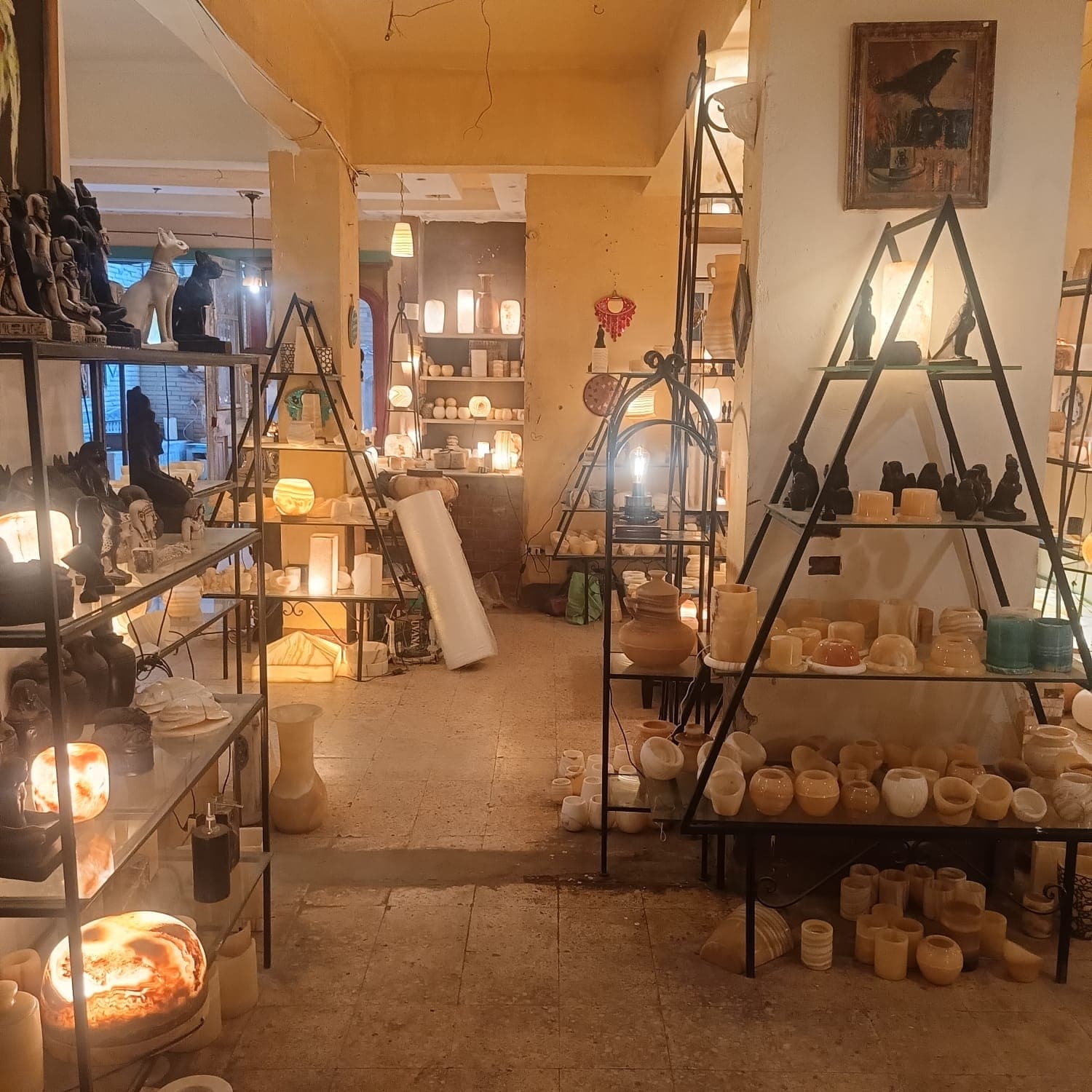
Calcite Alabaster (Egyptian / "Oriental" Alabaster)
Calcite alabaster, also known as onyx-marble or Egyptian alabaster, consists of calcium carbonate ($ ext{CaCO}_3$) and is geologically classified as a compact, banded travertine stone or stalagmitic limestone.
This variety is either a stalagmitic deposit from the floors and walls of deep limestone caverns, or a kind of travertine deposited continuously from springs of calcareous water. Its deposition in successive historical layers gives rise to the stunning banded appearance which the stone shows on cross-section. This is the authentic historical Egyptian alabaster, and it is significantly harder and more durable than its alternative counterpart.
Gypsum Alabaster (Modern Standard)
Gypsum alabaster is a hydrous sulfate of calcium with the chemical formula $ ext{CaSO}_4cdot2 ext{H}_2 ext{O}$. This variety typically forms through the sedimentary deposition of minerals in environments where water containing dissolved calcium sulfate evaporates over long periods, such as shallow land basins or coastal lagoons.
Historically, this stone was used throughout medieval Europe for religious statues and altarpieces. It is structurally much softer and highly water-sensitive compared to its robust Egyptian relative.
The Historical Rule of Thumb
While both stones can be carved into beautiful art, knowing their distribution map helps unlock their history. In general, ancient alabaster items recovered across the wider Middle East—including Egypt and Mesopotamia—are composed of calcite.
Conversely, objects produced during the Middle Ages in Europe are almost entirely composed of gypsum. Modern decorative pieces found on the market today are most likely to be calcite, but depending on their exact global sourcing pocket, they may be either mineral.
Identifying the Difference in Your Hands
The two varieties can be easily distinguished from one another right at home by analyzing differences in their relative hardness. The gypsum variety is remarkably soft, sitting at a 1.5 to 2 on the Mohs scale, meaning it can be readily scratched with a common fingernail.
The calcite kind is too hard to be scratched by a fingernail, sitting at a Mohs hardness of 3, though it yields readily to a steel knife blade. Furthermore, because calcite is a carbonate, it will immediately effervesce (bubble) upon being touched with a drop of mild hydrochloric acid, whereas gypsum alabaster remains practically unaffected under the same treatment.
Key Physical Properties & Translucency
Alabaster is characterized globally as a white stone, though it frequently presents with rich veins or clouds of alternative colors, including gray, yellow, honey, pink, or deep brown depending on surrounding trace minerals.
Perhaps its most distinctive and globally attractive property is its exceptional translucency—its innate ability to let light travel through its matrix. Premium grade alabaster can transmit up to 80% of light, making it the ideal choice for creating warm, architectural lighting layouts and ambient home design effects.