ALABASTER CRAFTSMANSHIP: FROM ANCIENT LATHES TO 2026 DESIGN TRENDS
The methods used to shape alabaster have undergone a dramatic evolution over the last 5,000 years. Yet, despite the introduction of advanced laser cutters and automated carving machinery, the core challenge remains unchanged: how to sculpt a delicate, brittle mineral without shattering its natural crystalline matrix. Let's look at how historical hand techniques mesh with modern industrial engineering to shape contemporary luxury lighting.
Ancient Extraction and Labor-Intensive Quarrying
In ancient Egypt, extracting pristine blocks of calcite alabaster from the earth was a dangerous, labor-intensive process. Workers used primitive tools to chisel deep isolation trenches directly into the rock face surrounding a desired block.
Once the trenches were deep enough, craftsmen cut small horizontal grooves along the base, inserted dry wooden wedges into the openings, and poured water over them. As the wood absorbed the liquid, it expanded with immense physical force, cleanly snapping the massive boulder away from the bedrock.
Copper chisels and bronze saws were also used, but because these soft metals wore down rapidly against dense calcite, ancient masons constantly introduced abrasive slurries made of water and sharp quartz sand to act as the primary cutting edge.
Traditional Hand-Turning and Workshop Lathes
Once a raw block is successfully pulled from a modern quarry, it undergoes 'squaring' to remove unstable excess stone before entering an artisan workshop. For spherical items, hollow bowls, and lamp bases, the block is mounted onto a traditional mechanical lathe.
As the stone spins, the artisan holds tempered steel chisels directly against the surface, paring away layers of mineral with millimeter precision. Following rough shaping, the artisan uses progressive sanding grids and fine buffing pastes to polish the stone, revealing its transparency and color gradients. Hand-carving remains highly viable today because the stone's innate softness responds beautifully to human touch.
Modern Industrial Techniques: CNC and Lasers
The modern stone industry has been transformed by Computer Numerical Control (CNC) machinery. Designers can now upload complex, multi-dimensional digital models into automated routers that carve intricate geometric patterns with zero margin for error and minimal material waste.
Laser cutting tech and 3D scanning software also allow workshops to inspect the structural density of a raw boulder before carving begins, mapping out natural veins to ensure the stone does not fracture during production.
The Historical 'Marmo di Castellina' Dehydration Trick
A fascinating historical technique in alabaster production is the creation of 'marmo di Castellina'. To artificially decrease the natural translucency of gypsum alabaster and replicate the dense, prestigious look of opaque Carrara marble, artisans developed a heat-treating process.
Finished alabaster statues are immersed in a water bath and heated slowly to just below the boiling point. This precise thermal exposure causes a partial dehydration of the gypsum mineral. If regulated perfectly, the crystal matrix shifts, taking on a solid, dead-white appearance that closely mimics premium structural marble.
2025–2026 Biophilic Design and Lighting Trends
In the contemporary design landscapes of 2025 and 2026, alabaster lighting has become an essential element for high-end interior architects. The ongoing rise of biophilic design—the practice of weaving natural, raw outdoor elements into indoor living environments—has placed a premium on tactile, non-synthetic materials.
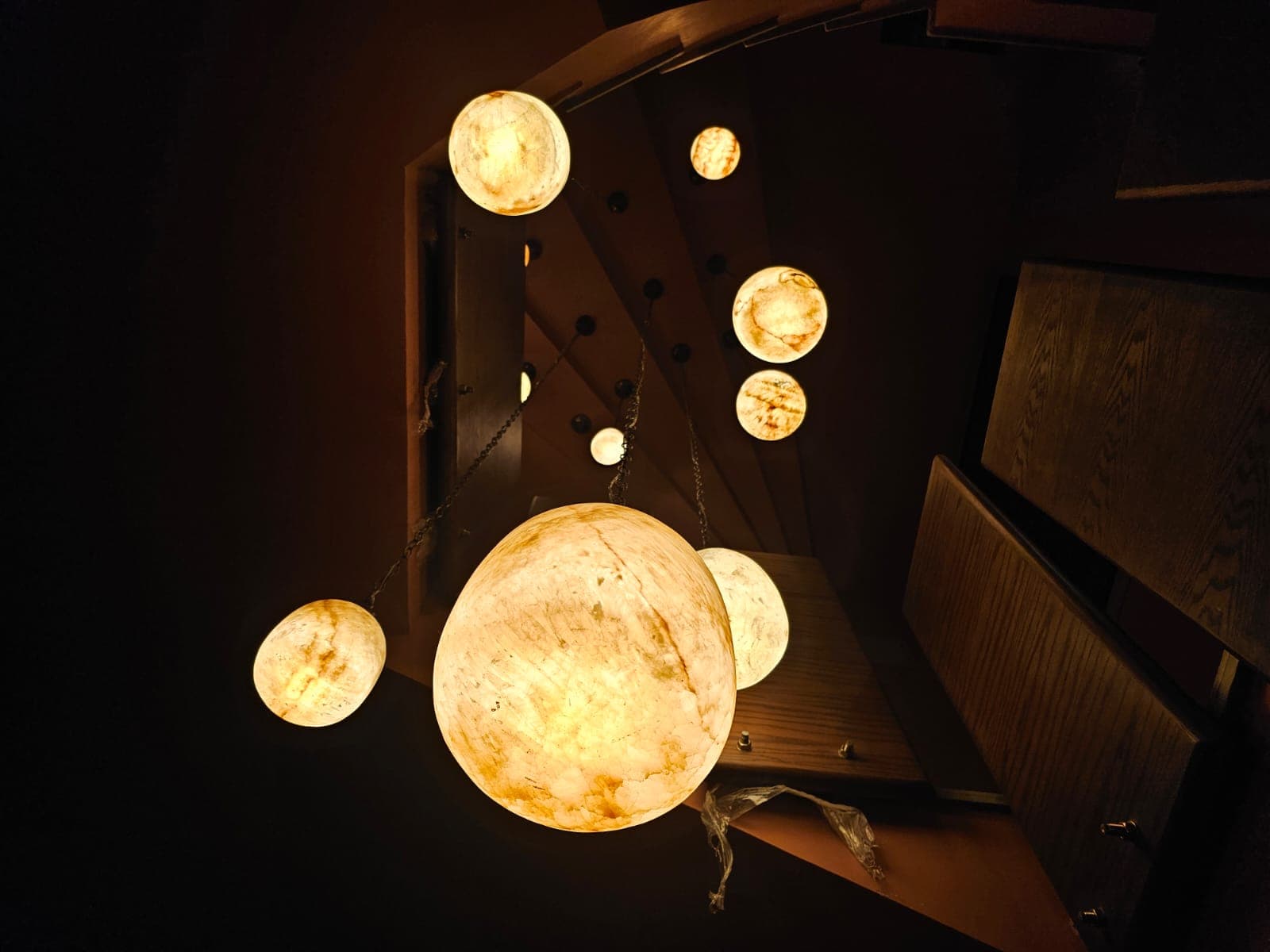
Unlike standard glass or plastic diffusers that block or direct light harshly, an alabaster sconce or hanging pendant acts as an active design partner. It shapes light, transforming a stark bulb into a warm, poetry-like honey glow that ripples across the natural mineral veins, making it a signature feature in modern minimalist lofts from Milan to Tokyo.
Real vs. Faux Alabaster: What Every Buyer Must Know
Because authentic natural stone demands intensive artisan handling, the market contains numerous 'faux alabaster' alternatives, typically made from poured chemical resins, acrylic plastics, or frosted glass formulas.
While faux fixtures offer a lighter weight and uniform look, they lack the soul and premium feel of earth-born mineral calcite. To spot a fake, look closely at the veining patterns across multiple pieces: manufactured alternatives display identical, repeating lines from a factory mold.
Natural stone is completely unique—because no two boulders share an identical geological history, no two genuine alabaster fixtures will ever look completely the same.